


|
Getting your Trinity Audio player ready...
|
Local leaders surrounded a mechanical arm as it cut the ribbon on New Bedford Research & Robotics’ new building last July.
The ceremony kicked off the renovation of a vacant property on Purchase Street, using $2.25 million in federal pandemic relief funds granted by the city. The grant took months to finalize — it needed “all manner of legal opinions” to fit into the complicated funding requirements, Mayor Jon Mitchell said at the ribbon-cutting.
“This represents a big bet of public funds,” Mitchell said. “I am fully confident that that is a really good bet that will pay off handsomely for the city in the long run.”
This “bet” was risky, according to an internal city report obtained by The Light. A six-page assessment completed in early 2023 said the New Bedford Research & Robotics renovation project had a “high risk” of failing to meet its goals or compliance requirements.

But so far, the city has kept other reports evaluating the grant’s risks a secret.
City staff, lawyers, and a consultant exchanged six memos about the project’s risk over the next year and a half, but the city has refused to release them to The Light. It claims all six documents can be kept secret under exemptions in the state public records law for attorney-client privilege and attorney work product.
The Light has been seeking public records about the $2.25 million grant since November, and it has been asking the city to release the memos since February.
The city has claimed that some of the memos, written by a city consultant and staffer, sought legal advice from the city’s lawyers on the grant, and that the other memos included the lawyers’ legal opinions on the grant.
“Government entities may assert the attorney-client privilege, despite the tension with the principle of government transparency embodied by the Massachusetts Public Records Law,” Associate City Solicitor Katherine Schuko wrote in a response to The Light in May.
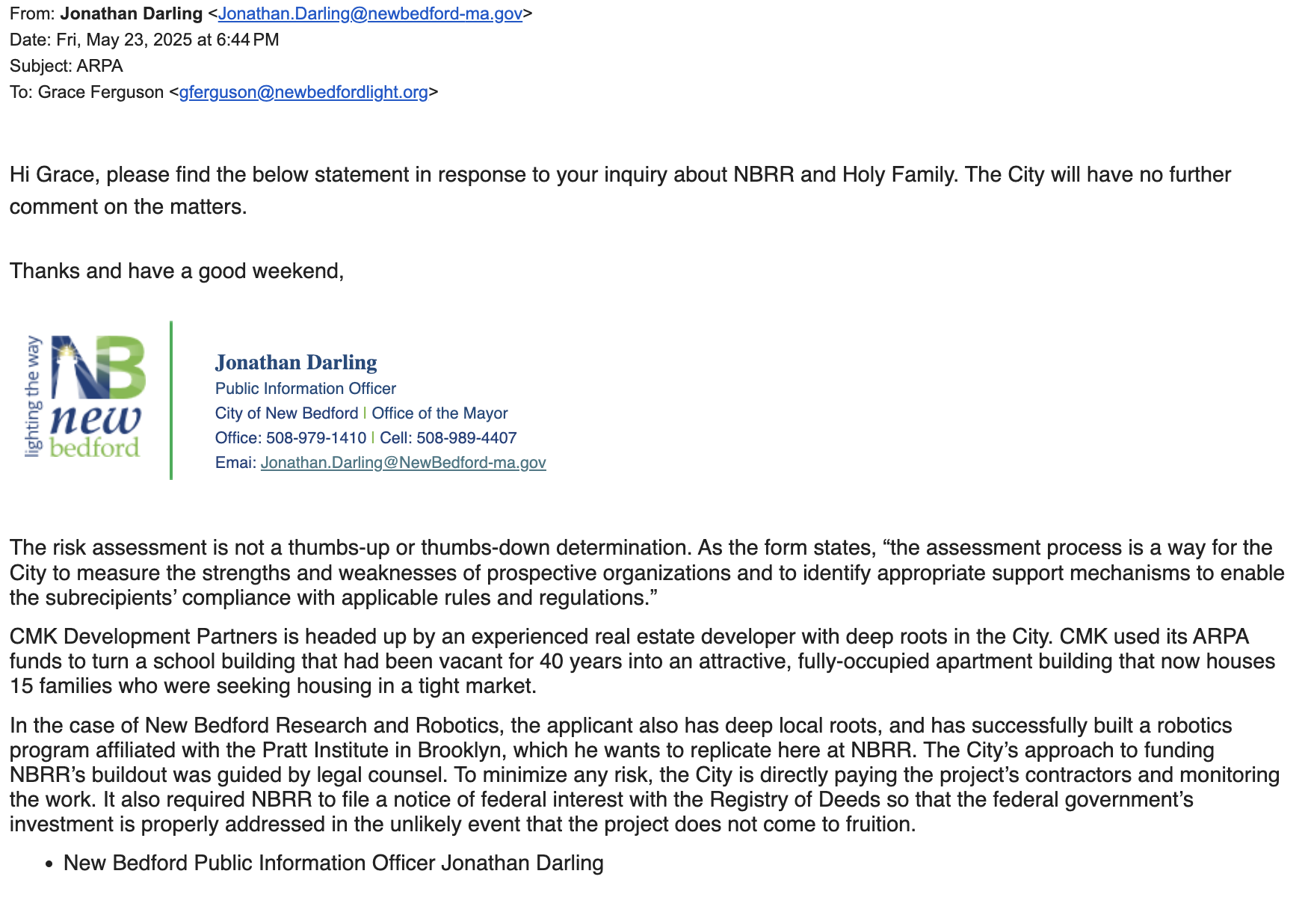
Public Information Officer Jonathan Darling declined to explain why the Mitchell administration chose to invoke this privilege. He provided a written statement in response to The Light’s questions about the grant last week. (You can read the statement in full here.)
Darling’s statement said the city took steps to “minimize any risk” associated with the grant, “guided by legal counsel.” It said the city is monitoring the work and paying contractors directly rather than having the money pass through the nonprofit’s accounts. “The applicant also has deep local roots, and has successfully built a robotics program affiliated with the Pratt Institute in Brooklyn, which he wants to replicate here,” Darling wrote.
The applicant is the nonprofit New Bedford Research & Robotics. Mark Parsons, its founder and executive director, said he didn’t know that the city had determined that the grant was risky.
“I haven’t been privy to any of this,” he said in an April interview with The Light. “Nobody sent me a risk assessment or a memo or anything.”
But Parsons said the content of the memos was “irrelevant” to him.
“I’m not going to get sidetracked by, ‘So-and-so said such-and-such,” he said. Instead, he said he’s focused on the renovation project — which is still in its early stages — and his nonprofit’s work.
This is one of three pandemic relief grants that the city awarded despite assessments by the city’s grant auditors that the projects were high-risk.
The city also awarded $500,000 in pandemic funds to the renovation of Holy Family High School into apartments, then later determined that the Holy Family grant was high-risk.
And the city gave $110,000 in pandemic-relief funds to the William H. Carney Lodge renovation in December after a reviewer’s warning that the lodge “cannot be entrusted to manage federal funds,” The Light reported in April. The city said it mitigated risks on the lodge renovation by paying vendors directly and inspecting the work. The Carney Lodge grant was one of six pandemic-relief grants the city awarded outside of a competitive application process, The Light has learned.
Robotics nonprofit leader reacts to city’s findings
A six-page risk assessment of the New Bedford Research & Robotics project is the only document The Light has obtained from the city that explains why auditors found that the grant to New Bedford Research & Robotics, or NBRR, was high-risk.
Parsons founded NBRR as a nonprofit in 2021. He had just returned to the South Coast, where he grew up, after leading a similar program at the Pratt Institute in New York City. NBRR runs robotics education programs for local students, conducts research for universities and private companies, and provides “incubation” space for small businesses.
Philanthropic grants fund some of NBRR’s programs. The nonprofit charges for some of its services, Parsons said: small businesses pay to be members of its incubation program, and companies pay the nonprofit for research and development contracts.
The nonprofit is using this pandemic relief grant to renovate the former Glaser Glass building at 1265 Purchase St., while working in the currently usable parts of the property. MassDevelopment, the state’s economic development authority, pitched in another $900,000 toward the project.
Plans submitted with NBRR’s grant application show the grubby industrial garage space transformed into a bright, futuristic innovation hub, complete with robot arms.


Most of NBRR’s pandemic grant is still unspent because the renovation is far from finished. The project team is currently working to stabilize the building, which deteriorated while it was vacant. Rising construction costs and unexpected problems with the building have drastically increased the project budget, Parsons said.
Parsons works in a small, dated office on the north side of the property. His head nearly touches the ceiling tiles when he stands. All the robots are out of sight in an unglamorous warehouse building toward the back of the lot.
The main building that’s visible from Purchase Street looks clean, bright, and buzzy in architectural renderings. Parsons said he wants to have big windows in front so the work being done there “spills out” into the neighborhood.
When he took a Light reporter and photographer on a tour of the space in April, it felt chilly and a little damp. Leaks in the ceiling had stained the walls. A couple of construction workers were boarding up the garage doors.


The project is far behind its original schedule — in its grant application, NBRR aimed to finish the work by summer 2023. Another project schedule that was included in risk assessment documents targeted June 2024.
The risk assessment and pre-grant process dragged on so long that the grant wasn’t even officially awarded until late April 2024, more than a year after the risk score was filed. Unanticipated work, like a stormwater runoff study required to replace the building’s roof, has also slowed the renovation.
The 2023 risk assessment came up with a score based mainly on the organization’s history, financial picture, and management structure. The higher the score, the higher the risk. NBRR’s grant received 39 out of a possible 48 points.
Any score of 33 or above, the assessment says, means “there is high risk that the subrecipient will fail to meet project or programmatic objectives or incur significant deficiencies in financial, regulatory, reporting, or other compliance requirements.”
This project scored so high because the young nonprofit lacked experience in managing grants, according to the assessment. The reviewer also found that NBRR didn’t have detailed financial plans in place that would enable it to meet the grant requirements.
NBRR’s accounting system didn’t identify program funding “separately and accurately” for each of its grants, the assessment said. It also found that NBRR had no internal control plan and no lead fiscal staff with experience in grant management. And it said the city grant made up a “large” percentage of NBRR’s overall funding.
“They were new,” said Molly Kivi, the former city grant auditor who prepared the assessment. “It is the best indicator of whether something is going to be high-risk or low-risk.”
NBRR’s age set it apart from other recipients of large pandemic grants around the city. Other, more established organizations that received grants of over $1 million, such as the YMCA, the Zeiterion, and the Whaling Museum, received low risk scores.
Read the risk scorecard ⇢
In a lengthy interview with The Light, Parsons said that he didn’t think the grant was high-risk, but said he wasn’t offended by the city’s findings.
“I think it’s reasonable for anybody two, three years ago [to] have said, ‘You’re gonna do what?’” he said. “I totally respect that.”
Parsons said the organization has done good work over the past few years, citing numerous examples. Academics from Brown University and Carnegie Mellon University have done research on AI and sound-absorbing materials. NBRR has researched better ways to stitch together carbon fiber nanotubes for an undisclosed aerospace company. And the nonprofit has provided advice and working space for a startup generating hydrogen for clean energy, he said.
The risk assessment process was “brutal,” Parsons said. It frustrated him because the city would ask him for information, then “go dark” for months. He said it contributed to escalating costs on the project.
But after seeing a copy of the risk scorecard, Parsons wrote in an email: “I was never really asked these questions, the scores don’t seem objective, nor do they accurately reflect the extensive experience and skills of our team.”
When The Light provided Parsons with city documents that show NBRR was asked nearly every question in the scorecard, he said that he thought the risk assessment was complete by February 2023, when the scorecard was written, and that NBRR was only providing answers to secure the grant.
“If someone hands you a form and says, ‘Fill this out for the grant,’ it comes across as a dry conveyance of information,” he wrote in an email. “If someone hands you the same form and says, ‘This is part of a risk assessment package, please fill it out,’ you attend to those responses quite differently.”
In a follow-up interview, Parsons said that if he had known the answers were for the risk assessment, he would have provided better documentation showing his organization had more experience and better internal processes.
Still, Parsons reiterated that he’s “not interested in pointing fingers at the city.”
What we know about the risk the city took, and what the city won’t tell us
Federal regulations required the city to complete risk assessments for all “subrecipients” of pandemic relief money — meaning organizations that carried out federally funded projects but weren’t the end users of the funding. NBRR’s renovation relies on design and construction work from outside firms.
“The risk assessment is not a thumbs-up or thumbs-down determination,” said Darling, the city’s public information officer, in his written statement.
Kivi, the former city grant auditor, agreed. She said a high-risk determination isn’t necessarily a reason not to give a grant.
Instead, the federal government requires a risk assessment to help the city determine what supports and guardrails it should set up to comply with federal rules on how the money can be spent.
NBRR’s high-risk assessment meant the nonprofit would need extra guidance and monitoring from the city. The city is paying contractors directly, instead of through NBRR, and monitoring the work.
“It also required NBRR to file a notice of federal interest with the Registry of Deeds so that the federal government’s investment is properly addressed in the unlikely event that the project does not come to fruition,” Darling’s statement continued.
The notice says the Purchase Street property must be used for its “originally authorized purpose” as a robotics center for the next six years, unless it gets approval from the city to do otherwise.
NBRR filed the notice this May, a year after the grant was finalized — and just a few weeks after The Light contacted Parsons about the risk assessment.
Kivi completed her scorecard in February 2023 and resigned three months later. The risk assessment process stretched on for the next year. Darling’s statement didn’t address The Light’s question about why the assessment process took so long.
The memos that the city is keeping secret could show what happened during that yearlong assessment, but the city has repeatedly refused to provide them to The Light.
That means the public can’t access information about how the city managed the potential risks for one of the largest pandemic grants it awarded.
To keep the memos out of the public eye, the city has claimed exemptions from the state public records law that protect attorney-client confidentiality and legal opinions written by lawyers. Darling declined to explain why the city is choosing to invoke those exemptions.
The six memos were filed between May 2023 and October 2024. Three of them were written by a city consultant on pandemic funding, including two that were co-authored by a city auditor. The city claims that those memos don’t have to be released because the consultant was “seeking legal advice” from city lawyers. The other three memos, the city says, include legal opinions on the grant from city lawyers.
The consultant, Richard Taylor, and the city auditor, Jennifer Maxwell, declined to comment for this story. Maxwell no longer works for the city.
City doesn’t address questions about nonprofit’s lease
The city awarded the renovation grant to the nonprofit New Bedford Research & Robotics — but a for-profit business also controlled by Parsons actually owns the building the nonprofit is renovating.
The nonprofit pays rent to Parsons’ business, an LLC called Southcoast Research & Robotics. The lease also makes the nonprofit responsible for utilities, maintenance, insurance, and taxes.
Darling did not answer The Light’s question about why the city awarded the grant to the nonprofit instead of the business.
The Light also asked Darling what would happen with the federal grant money if the business were to sell the building. Darling didn’t directly address the question, but his statement refers to the notice of federal interest filed with the registry of deeds in May, which he said was filed “so that the federal government’s investment is properly addressed in the unlikely event that the project does not come to fruition.”
That notice, and the grant agreement, place restrictions on what the nonprofit can do with property that’s “acquired or improved” with federal funding. The grant agreement says the grantee has to get instructions from the city if it “seeks to encumber or dispose of the property,” and the city can choose from a range of options that all involve compensating or transferring property to the U.S. Treasury.
But it’s not clear how either agreement would restrict what the business can do with its building. The grantee is the nonprofit, not the business.
Parsons said that his original plan was for the nonprofit to buy the property, but he wouldn’t have been able to get the financing that way.
“No bank was going to give a mortgage to a nonprofit that wasn’t a juggernaut nonprofit — just wasn’t gonna happen,” he said. “So, there had to be a for-profit entity that made more sense to the bank.”
Parsons added that he intends to eventually transfer ownership of the property to the nonprofit, though he didn’t have a specific timeline.
The LLC bought the property for $1,200,000 in December 2022, with a $840,000 mortgage from BayCoast Bank.
Parsons said he negotiated the lease with the nonprofit’s board of directors so that rent payments would cover the mortgage “plus a small, very small increment on top.” A spokesperson representing Parsons later contacted The Light to clarify that Parsons “was not engaged in direct negotiations with the board on lease terms,” and instead was represented in negotiations by a lawyer.
NBRR owed monthly rent payments of $7,250 to the LLC in 2023, the first year of the lease. Bank records submitted as part of the risk assessment process show that the LLC’s monthly mortgage payments in the first eight months of that year ranged from $4,410 to $4,883.
The lease set annual rent increases over its 10-year term. This year, the nonprofit’s monthly rent increased to $14,602. By 2032, the monthly rent will be $19,215.
During lease negotiations, it wasn’t clear how much the final monthly mortgage payments would be, Parsons said. They will increase in the future: The initial two-year mortgage agreement only required the LLC to pay the interest, but not any of the principal. The loan still hasn’t transitioned out of the interest-only phase because the renovation isn’t done, he said.
Parsons declined to answer follow-up questions about how much the current mortgage payment is.
Holy Family apartment conversion also called high-risk
NBRR’s grant is one of the three high-risk pandemic grants the city gave out.
The renovation of Holy Family High School into 15 mixed-income apartments was also high-risk, city documents show. The city provided $500,000 in pandemic funds for the project, on top of $875,000 from a separate federal housing program.
CMK Development Partners finished the project at the beginning of last year — on-time and on-budget, according to the developer. The building quickly filled with tenants, and there were more than 100 people on the building’s waitlist by November.
Colleen Kavanaugh, chief operating officer of CMK, said she knew the city had assessed the project for risk. But she said the city never told her the project was deemed high-risk.
“I have no idea why someone would have come to that conclusion,” she said.
The Holy Family risk assessment, also completed by Kivi, outlined similar problems to the NBRR grant — the company behind the project was new to federal grants and didn’t have robust financial systems, her report said.
Kavanaugh disputed nearly every score in the risk assessment. She said the project team did have staff familiar with federal grants and other compliance requirements, and it did have detailed accounting procedures.
The issues raised in the report are moot, she said, because CMK successfully completed the project and met all compliance requirements.
Kavanaugh also said CMK was never asked the questions listed in the risk assessment.
Kivi said the risk assessment was based on either grant documents or an interview with the grantee, though she couldn’t remember which. She said that the risk assessment was about the specific organization that received the grant. The Holy Family grant went to a separate LLC that the leaders of CMK established in 2021, rather than CMK itself.
Kivi noted in the risk assessment that “a founder of Holy Family failed to disclose a conflict of interest to an employer in 2016.” In an interview, Kivi said she was referring to a 2018 Boston Globe story about Gerry Kavanaugh, the CEO of the development firm and Colleen Kavanaugh’s husband.
While Kavanaugh was interim chancellor of UMass Dartmouth, he did not disclose that he had been hired as a consultant for a company working on a plan to attract students to another college campus, the Globe reported.
Colleen Kavanaugh declined to comment on that line in the risk assessment. Gerry Kavanaugh did not respond to a request for comment.
The risk assessment was completed in January 2023, months after the city awarded the grant to Holy Family in September 2022. By the time the report was filed, most of the pandemic grant money had already been spent, Colleen Kavanaugh said.
Risk assessments were required for all pandemic relief grants to ensure proper oversight of the funding.
Darling, the city’s public information officer, did not directly address The Light’s question about why the Holy Family risk assessment was completed after the grant was awarded. He also did not answer questions about what action, if any, the city took to mitigate the risks of this grant.
“CMK Development Partners is headed up by an experienced real estate developer with deep roots in the City,” Darling said in his written statement. “CMK used its ARPA [pandemic relief] funds to turn a school building that had been vacant for 40 years into an attractive, fully-occupied apartment building that now houses 15 families who were seeking housing in a tight market.”
Some projects bypass competitive process
In another case, the city awarded $110,000 in pandemic funds to the Carney Lodge renovation, dismissing a city auditor’s finding that the grant was high-risk, The Light reported in April. The lodge’s risk assessment included stark warnings that a lodge representative had provided “repeated and blatant misrepresentation of facts” and “adamantly refuses to follow federal procurement law.” The city has said it paid the lodge renovation vendors directly to mitigate risk.
The City Council awarded an additional $215,000 in Community Preservation Act funds for the lodge after The Light’s report in April.
The Carney Lodge project received funding outside the competitive application process that other vacant building projects went through.
City officials previously said that the mayor has the authority to decide which organizations receive pandemic relief funding, and federal law doesn’t require the city to award the money through a competitive process. The city followed all federal requirements in awarding the Carney Lodge grant, they said.
Six pandemic relief projects, including the Carney Lodge, were selected outside of a competitive application process, city records show.
Two grants went to public entities: a $3 million vacant property initiative managed by the New Bedford Redevelopment Authority, and a $1.5 million reconstruction of Leonard’s Wharf by the New Bedford Port Authority.
The other non-competitive grants that went to private entities totaled about $1.8 million. They included $1.5 million for a YMCA renovation and expansion, $250,000 for an offshore wind workforce development center at Bristol Community College, and $40,000 for an indoor farmer’s market run by Coastal Foodshed.
The grants came out of an $82 million funding package the city received from the 2021 American Rescue Plan Act. New Bedford set itself apart from other cities by focusing on big construction projects, rather than short-term programs. The money helped build new housing, renovate local nonprofit spaces, and improve city infrastructure.
The city met a deadline on Dec. 31 last year to finalize its spending plans. Any money not spent by the end of 2026 must be returned to the federal government.
Editor’s note: Mark Parsons is a member of The New Bedford Light’s Advisory Council. The New Bedford Light’s newsroom is scrupulously independent. Only the editors decide what to cover and what to publish. Founders, funders and board members have no influence over editorial content.
Email Grace Ferguson at gferguson@newbedfordlight.org
Editor’s note: This story was updated on Friday, June 6, 2025, to add comment from a Mark Parson’s spokesman clarifying that Parsons was not in direct lease negotiations with the New Bedford Research & Robotics board of directors. The subhead was updated on Thursday, June 12, 2025, for clarification.


The common law attorney client privilege can be asserted as an exemption to the Public Records Law, if you want to challenge it, let me know.
If the City can’t invest in “high risk” projects, we never would have revitalized the waterfront historic district. We wouldn’t have saved the Zeiterion. Whaling was as “high risk” an industry as you will find and it put us on the map. When whalers invested in building Wamsutta Mills in 1848, that was “high risk.” Thank goodness for City leaders who are willing to invest when something isn’t a sure thing.
Hold on……….it should be a choice for the residents. It’s our meeting ney because we will be burdened with higher re taxes. Be real! Would you give you child a drinking glass and have them run across the traffic, hoping they don’t get hit or fall and get cut… As for the mills they are long gone!
I have respect for you Mr. Bullard and your opinions. And I hope these decisions, these choices in investment of allocating grant funding
to these projects are good decisions. Fingers crossed.
Why am I not surprised. Any steps moving forward, the mayor puts to sleep thus continuing to keep New Bedford in a negative light. The STAR building opened my eyes.
I have been here a short while (5 Years) and I cannot believe the mistakes and favors and poor management all around. It starts at the top. We can’t even drink the water. I filter it 5 times before I use it.
I feel like Trump has permeated through this government in this city. Let’s bring democracy back and stop the favors and greed and money shifting. Do your jobs!!
all they have to do is have their “policy documents”, walk through the lawyers office with galoshes on…. and they’re all set defy the public records laws, which remains a toothless joke…
Taking high risks can lead to high rewards…the City needs to encourage risk takers…that’s how good things happen.
I need the city to give me 2 million dollars so I can buy up a bunch of commercial land, pave it, build glass boxes on them, then hold the properties for decades without leasing them to anyone in hopes the property appreciates 50x. In the meantime, I’ll write off depreciation and expenses on my taxes like a true ‘risk taker.’
That about covers it!
If you are the Michael P that graduated from NBHS 1979, well then I would have sense of comfort because you really built yourself an empire. The thing is other individuals are not as successful. It would involve NB residents money not a lone persons. So no, residents should not let this go on. You on the other hand run for Mayor and with all the Panagakos signs thought NB residents see, you know what your doing. I understand someone possibly gave you a chance when you started but you did not have the financial responsibility of the taxpayers on your shoulders. Classmate 1979 NBHS.
Water run off study…… that is all I needed to read. The cost and time associated with doing business with NB and all the political red tape that surrounds renovation projects like this is the reason they fail. Unless you are in the politic game getting permits in a timely fashion approved to keep your project on time and under budget just won’t happen.
With the federal debt nearly 35 Trillion dollars, and the interest on the debt 1 Billion dollars in 2025, every nickel of the pandemic funds that weren’t used for that purpose should have been returned, or taken back by the federal government. That debt is close to being too large possibly repay, but everyone will see, and feel that within the next 3-5 years with higher tax rates on everything, and federal, state, and local services cuts will have a negative affect on everyone.