


|
Getting your Trinity Audio player ready...
|
Cheech and Chong, Tom and Dick Smothers, Dean Martin and Jerry Lewis, Bert and Ernie. These comedy duos have stood the test of time. Add to that roll call Derrick DeMelo and Brian Martins, known as The Portuguese Kids, who have achieved the 20-year milestone in their comedic career.
What began as a show at Bristol Community College for family and friends snowballed through the years into a multi-faceted enterprise: standup comedy, YouTube videos, interactive shows, improvisation, e-commerce, and an internationally broadcast hit show, “Portuguese Problems,” on RTP.
Along the way, they’ve racked up nearly 300,000 followers on Facebook, roughly 160,000 on Instagram, and a gazillion views of their hilarious videos (check out “The Malassada Song” on YouTube), not to mention many miles traveling to gigs as far-flung as Portugal, California, Australia, Canada, and the United Kingdom.

The creative partners have spun off their e-commerce business, which helped keep them afloat during the pandemic shutdown, but are venturing into podcasts and are developing a travel show with Dean Camara, who co-directed “Portuguese Problems.”
This year, DeMelo and Martins plan to bring back their interactive “My Big Fat Portuguese Wedding” shows, which COVID knocked off the schedule.
Collaborators Mike Rita, Vanessa Medeiros, and Taylor Amarante add their own comic talents to The Portuguese Kids mix.
The men credit their wives as contributors to their success. “You have to have a certain type of person who’s your significant other to do something like this,” said DeMelo. “To see the dream,” Martins added. He lives in Somerset with his wife Jessica and a teenage daughter, while DeMelo resides in Fall River with Emily and two young sons.
In this conversation with The New Bedford Light, Martins and DeMelo talk about growing up in Fall River as children of Azorean immigrants, their creative process, and how they mine their culture for comedy that resonates beyond the Portuguese-American audience.
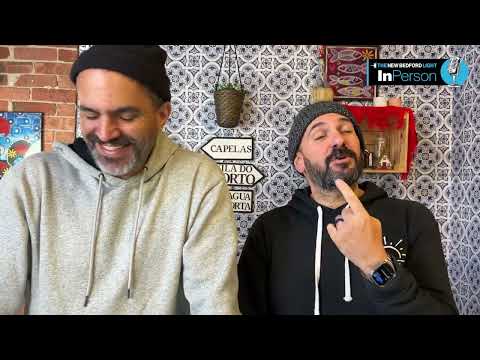
New Bedford Light: Where in Fall River did you grow up?
Derrick DeMelo: I grew up in … basically, the Bedford Street area. It was not a neighborhood (like Corky Row or The Highlands), but it was, in essence, a very peculiar neighborhood. Because I would say — this is a guesstimation — probably 75 percent of the people in those four or five streets that I grew up around were all from the same village (Agua Retorta) in Sao Miguel, which is, coincidentally, where Brian’s mom was born and grandmother lived. … Brian and I have been friends since 6 or 7 years old.
Brian Martins: My grandmother happened to live in the apartment building right on the side of where Derrick’s parents were living. So, whenever I went to vovó and vovô’s house, when my parents would drop us off so they could go to work, I would go over to Derrick’s house and play video games, and their family would feed me, and vice versa. …
Sometimes we make comments about, life imitates art, art imitates life: I would go over, and his family would have dinner or lunch, and I knew I was going to eat. It wasn’t like I had to ask him. It was just expected. Because when my friends came over, we did that for them as well. … My mom loved that she could feed friends and family. That was something our parents and our elders knew: “We’ll always take care of each other. Don’t worry about it.”
NBL: What were your original careers?
BM: I was in human services, so I would work in group homes. I worked it out where, if I could get a first-shift position, then I could be doing the shows at night… That’s what I was doing during our tenure of just The Portuguese Kids, the early days.
DD: I was in sales. I could sell ice to an Eskimo, as they say. I was in retail most of the time, but right before I left, I was in banking. … I could have been a manager if I wanted to. At one point they were vetting me for that. I was doing very, very well for myself. You know, nowadays I slap myself. I’m like, “Damn, I should have saved more money back then.”
NBL: How long did it take for you to realize you could make this your living?
DD: We just did a conference with some Portuguese youth leadership. And they were asking us about that — “When did you realize?” From the get-go, when we started this, the plan was “How can we do this full time? How can we crack that nut?”
BM: It was the passion. Where I was working, I became a house manager, so I made it to the top. … I was finally at the peak. But it wasn’t fulfilling like when I would go away on a Saturday [to do] a show in California, or wherever we’re going, and [get] those laughs. That was the most fulfilling. When the night was done, I was like, “Wow, this really felt like what I was supposed to do today.” Then you’d go to work, and it was like “This isn’t it. This is just holding me over.”
NBL: The distinctive blending of Portuguese and English which some call Portinglês is familiar to many in the South Coast. How big a factor is it in your comedy?
BM: I would say it’s pretty big. When we started traveling outside of our area, and we noticed that our jokes we were making here — maybe not a local reference, but maybe it was the Port-English or frying fish in the second kitchen — also happened there. … In California, we learned quickly it wasn’t a basement where they were frying fish; it was in the garage, because they don’t have basements. But the Port-English was so big that it was wild to see every community getting it.
DD: With our parents, we filled in the blanks. That’s really what Port-English is. It’s kids filling the blanks and creating hybrid words. If you ever heard me speak to my mom, I will bounce back and forth from English to Portuguese. So, I’m an artist with that stuff, I feel like it is my canvas. …

Kids of immigrants, they inherently speak that second language. When you look at “The Sopranos” and the big inside joke with how “gabagool” is actually capicola, that is the same exact thing as Port-English. Italians came from Sicily to the New Jersey area. They spoke a certain way. Their kids started mixing it with English, and all of a sudden 20, 30, 40 years later, capicola is “gabagool.”
BM: It was just so crazy how we all were doing that. Like everybody was hearing the same type of Port-English. No matter where we went, those jokes always “hit” because they’re like, “Yeah, my parents, too.”
DD: So, for us, it’s been a really great way to connect globally.
NBL: The humor seems affectionate to me, but do you ever get pushback from people who are offended?
BM: Sometimes I get comments like, “Well, I wasn’t raised this way, so it can’t be real,” you know? … Sometimes we’ll respond “It’s fine if you didn’t grow up like this, but some of us did. Maybe the next (joke) you’ll relate to.” Sometimes you just get people, they’re there to hate — there are a lot of keyboard warriors.
We understand that maybe you weren’t raised this way. Maybe your parents didn’t have this dialect or this accent, but read the room — other people were raised this way.
DD: I think a lot of people looked at the name that we chose — The Portuguese Kids — and they assumed we were trying to represent what it was like to be from (mainland) Portugal. In essence, though, what we were trying to do is show people what it’s like growing up as kids of immigrants.
In the beginning, it took a little while for some of those people to get it, because “Hey, they’re not Portuguese, they’re American.” … Even sometimes because we’re from Fall River and Fall River is so Azorean, people even make that comment, that you guys should call yourselves The Azorean Kids, not The Portuguese Kids.
NBL: Can you describe your creative process?
BM: Sometimes it’s an inspiration from an improv scene we did on stage. We’ll come back and get some of the jokes down and just hit those points in between. For the most part, having something written out is very helpful, because [if you’ve learned your lines] you don’t have to think about what you’re saying. …
In improv … maybe you delivered a line wrong, but I’ll bring it back around and get the joke. [With video] we need to get those shots down. So, it is a mix of that and then sometimes anything that goes on at home.
(In an earlier part of the conversation, Martins gave an example.)
I have a sister, and she is my [inspiration for] everything about understanding how different I had it compared to her, because I could do everything [as a boy]. But seeing the way she had to come up and how strict my parents were with her really opened my eyes to how different we really had it. And then the comedy of it all, just to be able to pull from that, do a video sketch. You have other people, daughters of immigrants, and they’re like, “Yep, yeah, this was exactly [it], a curfew up until I was 30.” It’s crazy! And you laugh, but you know, there’s a little bit of truth in that.
DD: For us, it’s kind of, when the moment strikes, it’s like “Oh, my God. A really funny idea just came to me” — because that’s how our creative process is. We don’t look for that stuff. We wait for it to come to us … I’d rather it come to me, because when it comes to me, I know that it’s 100% great. You know that this is perfect, this is gonna be a good one.
NBL: You appeared with your moms on an episode of “Maria’s Portuguese Table” with Maria Lawton, cookbook author and food TV personality. How does Maria’s success inspire you?
DD: First of all, I feel like — and I’m sure she’ll tell you this, too — we actually had a hand in her success. We filmed her pilot (which got picked up by PBS). … So, for us to see that, it’s amazing, because we saw what everyone else sees in her a long time ago. We really encouraged her to pursue that, go for that. Seeing her success is just amazing.

BM: Maria was almost a reflection of us, in a sense, where there was a purpose behind why you’re doing this stuff, right? Yeah, everybody wants to be famous, but [in Maria’s case] it was “I want to do these recipes to connect. I don’t have these aunts anymore, and my mother and … we’ve got to pass these on.” And for us, that’s always been our thing, doing these sketches where we put parents in funny situations, how we all went through this, and having this connection … One of our closest, closest friends in the Portuguese community is Maria, bar none. We’ve loved her forever.
NBL: What Azorean food can’t you live without?
BM: Oh, man. Oh, I would have to say the traditional Azorean steak with either the round-cut fries or straight, with a lot of the sauce. I need that big red pepper on top and the egg fried, ready to go. That’s No. 1 for me. When I go out and order Portuguese steak, I always have to see how it’s prepped, but I need to see that pepper on there and the egg. For me, that’s my go-to No. 1 I don’t think I could live without.
DD: Man, I’m going to have to cheat. I want to say anything my mom makes is something I can’t live without. When she goes, I’m screwed. … I would have to say octopus, if I had to choose something — an octopus stew really hits home. My flavor palate is pretty wide. I do like a variety of things, but I love seafood. In the Azores, everything you get is fresh, but the seafood is always a win.
BM: I love when Maria (Lawton) tells a story about how she had to get recipes. I always tell my wife, [whose heritage is Irish], “If my mom’s giving you a recipe, just do the Maria Lawton thing. Bring a measuring cup with you, so when she says, ‘Oh, it’s this much salt’ tell her, ‘Nope, put it in here first.’ Then write it down.’”
NBL: What’s the best part of working with your friend?
BM: The best part of working with my friend — especially Derrick — is knowing that I can have the most random idea. It feels like it doesn’t make sense, and then I’ll say it out loud, and then he’ll be like “Oh. Let me rearrange it. You mean like this?” And then it’s like, “Oh, we’ve got something.” The fact that I can bounce ideas off of him and he’s able to bounce them back, and support — in improv it’s called “Yes, and” — “Yes, I hear you, and here’s my response.” And the fact that we can do that, and I know I’ve got that backup, really helps with the creativity side for me.
DD: The best part of this guy is that he is one of the few people on this Earth who understands how I think, and beyond my business partner, he’s my best friend. We spend more time with each other than we do our families, so I think the best part about our friendship is that we get along. We also don’t get along at times, but the fact that we spend so much time together, we become brothers in such a way that it really doesn’t matter. We can literally say — not the worst — we don’t say that bad of a thing, but sometimes we get heated, and the next day, it’s like nothing happened. That’s really the key to a good friendship and a relationship: You know that you can move on, that it wasn’t meant, and you can move on beyond that.
Joanna McQuillan Weeks is a freelance writer and frequent correspondent for The New Bedford Light.
This interview has been edited for length and clarity.


I believe Herman Melville refered to them as “Por-ta-gees”!
I would like to know when the Portuguese kids are playing locally.