


|
Getting your Trinity Audio player ready...
|
Tucked along a corner of the New Bedford State Pier’s East Wharf is a small ferry, the lifeline for a windswept island in Buzzards Bay.
The Cuttyhunk Ferry not only delivers passengers to and from the island of the same name throughout the year, but supplies too.
“We were there for 20-plus years … everybody knew to go right there,” Jono Billings, the ferry’s longtime operator, told The Light, pointing to the State Pier’s now-empty South Wharf.

Then, late last year, state officials found the century-old wooden pier had major structural issues and closed sections of it. The ferry, along with other businesses, had to leave parts of the pier’s East and South wharves.
It’s only the most recent closure along the dilapidated State Pier, built in 1913. A portion of the North Wharf has been closed since 2019. While the multimillion dollar repairs there could start later this year, only a portion of the dock is left available for use.
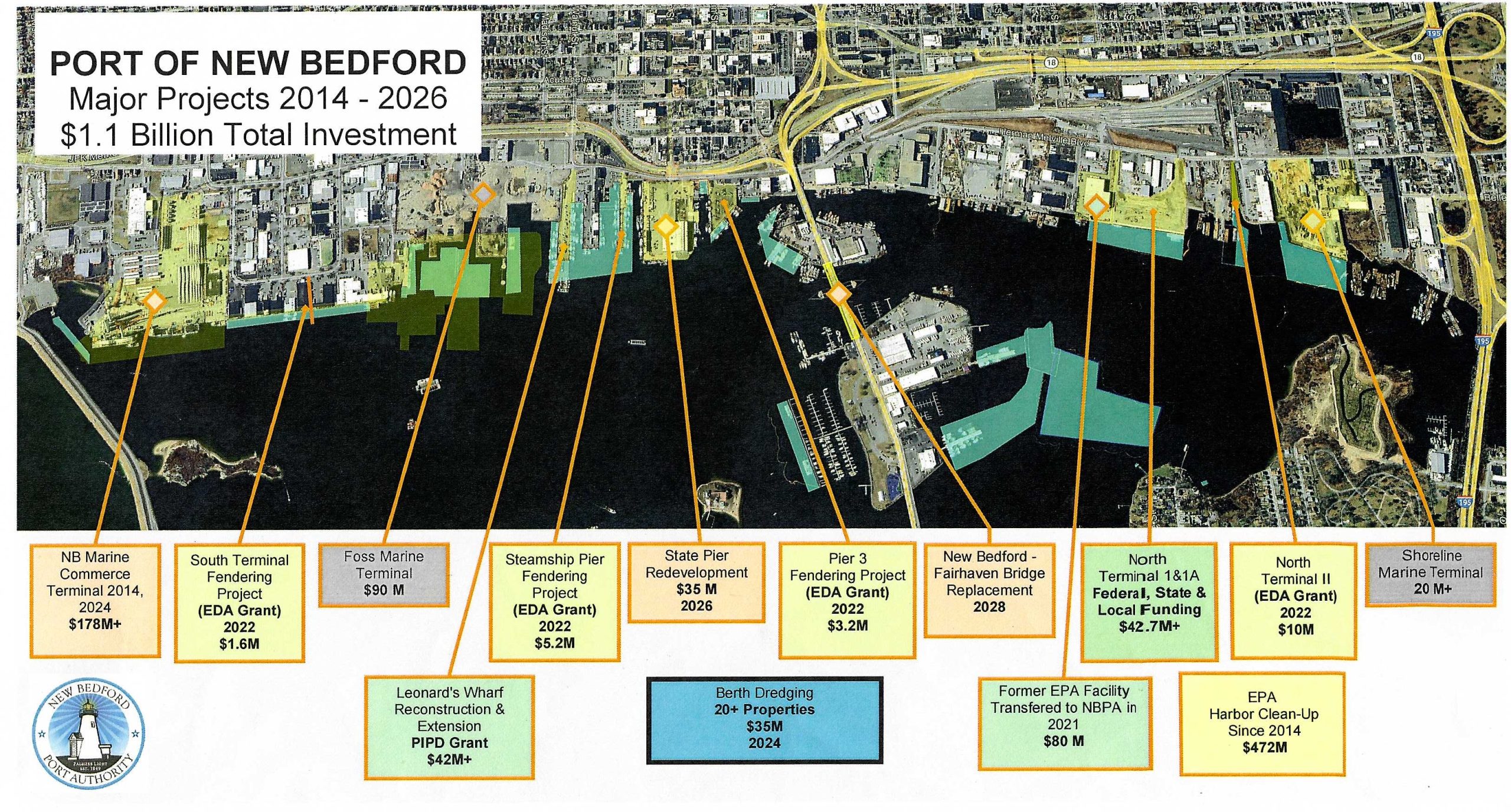
The mostly-closed state asset sits in an otherwise heavily-invested-in port. City officials have facilitated over $1 billion in funds to build, repair and expand maritime infrastructure since 2014, Mayor Jon Mitchell told The Light.
“The biggest thing going here is what we’re doing on the water,” Mitchell said of the city.
The loss of docking space along State Pier has created a squeeze along New Bedford’s working waterfront. Businesses displaced by the closure have relocated. Commercial fishing boats that once docked along the state-owned asset now jockey for space in other cramped wharves. City officials are trying to mitigate the congestion.
Without a definitive timeline on when years-awaited repairs to State Pier will be completed, elected officials acknowledge the need for urgency — and are calling on the state’s managers of the neglected pier to begin the design process.
Status of New Bedford’s piers
Hover over/tap each pier for information ⬇
State Pier’s derelict North Wharf
In seven years, the state has made little progress to fix the State Pier’s closed North Wharf, aside from some repairs made in 2023 on a small portion of the dock for continued ferry service.
This August, state officials solicited bids for a contractor to complete the estimated $31 million in repairs. The work could be completed in just over a year from the start of the contract, according to the state’s solicitation. Bids are due Oct 1.
But the damage to the State Pier is so extensive that whoever wins the bid will have to hire a licensed engineer to evaluate the structure “prior to developing any plans for loading” equipment onto the wharf, solicitation documents show.
“I want to get these things back online as quickly as possible,” Gov. Maura Healey told The Light in an exclusive interview in August. “Every day these things aren’t up and functioning, that hurts fishermen. It hurts families. It hurts our economy.”
The repair work could be one step closer to putting State Pier back online.
Fixing the State Pier’s recently closed South Wharf is even further off. New Bedford Port Authority Executive Director Gordon Carr told The Light that state officials are still in the planning stage for the South Wharf repair.
Mitchell said MassDevelopment, the agency that manages State Pier, doesn’t have the bonding capacity to pay for major repairs. The Healey administration would have to go to the Legislature for that, according to Mitchell.
He added that New Bedford sometimes is left out of the conversation when it comes to port investment in the state. MassPort in Boston, by contrast, is “all in front of state legislators and state government … it’s evident before them.”
“New Bedford is, let’s just say, far afield,” Mitchell said. He added that advocating for the city’s port projects is “at every turn, an exercise in reintroducing state government to New Bedford.”
‘Commercial fishing vessels are being squeezed’
Last year’s closure of yet another chunk of State Pier’s docks was swift following the revelation of damages. State and local officials say the repairs could take three to four years — after the design phase has been completed.
Billings, the Cuttyhunk Ferry operator, relocated his ferry to a different spot on the pier, but he says the location poses issues.
That includes not being able to get people in wheelchairs onto the ferry’s lower deck without a “special people mover.”
“The other issue is an extreme exposure to the northeast,” Billings told The Light. “When a big storm comes in, like last winter, the boat would get mashed… it would be bad.”

Other businesses didn’t land a spot nearby. Fishing boats that used to dock at the State Pier were relocated, some ending up north of the New Bedford-Fairhaven bridge.
“A whole bunch of fishing boats also got kicked out of here,” Billings said. “That was uncool, in my humble opinion.”
American Cruise Lines, which has been making port calls to New Bedford for over two decades, was also displaced from the State Pier.
The company received exclusive berthing rights to Pier 3 for its cruise season from city officials, The Light reported, a decision that caused tension along the waterfront — and caught the attention of at least one state legislator.
And the Schooner Ernestina-Morrissey also had to find another area to dock. The historic vessel is currently tied up near the Foss Marine Terminal, just south of State Pier.
“It is imperative that we now turn our full attention to State Pier before our port suffers irreparable harm,” state Sen. Mark Montigny said in an August letter to Gov. Healey obtained by The Light.
“Commercial fishing vessels are being squeezed by the need to accommodate cruise ships at a nearby municipal pier after being displaced from State Pier.”
Many fishing vessels have had to move from prime dock space at the State Pier, Leonard’s Wharf, and Pier 3 to other landings in the harbor due to closings and renovations.

A closed portion of State Pier’s East Wharf. Work on other areas of the state-owned dock in much need of repair could start later this year. Credit: Nathan Collins / The New Bedford Light
Complaints stalled State Pier redevelopment
While the state decides how to repair the State Pier, it’s also considering an economic development plan: what should be built atop it.
The idea to revitalize State Pier has been in the works as far back as 2015, according to New Bedford officials. It has “been the subject of talk in previous administrations as well,” said Mitchell, who became mayor in 2011. “But here we are in 2026 and we’re still, like, nowhere with it.”
After soliciting firms interested in the redevelopment effort, MassDevelopment named Taber’s Wharf Partners LLC as the recommended partner for the project in 2022.

The company — a “group of various maritime businesses,” according to city officials — unveiled plans for a new seafood auction house, restaurants and offshore wind facilities to the public later that year, The Light reported.
But the vision hit a snag when five state representatives sent a letter to Healey alleging the process that landed Tabor Wharf Partners the gig was “flawed, exclusionary,” and that New Bedford city officials had a hand in the selection process.
Mitchell told The Light in an exclusive interview that the state representatives’ 2023 complaints were wrong “as a matter of law.”
“We can’t collude with anybody on a bid that we’re not part of,” Mitchell added.
After the letter, MassDevelopment officials rescinded Taber’s Wharf Partners’ provisional award in June 2023 and issued a new request for proposals later that year. Seven proposals were submitted in 2024.
MassDevelopment and architectural firm Utile, Inc. analyzed the proposals and unveiled two proposed designs in July 2025 for improvements to the State Pier. They included plans to move the ferry terminals to the other side of the pier, continue to use the pier for industrial and storage space, and expand its use to retail space, including a restaurant.
But since late 2025, when state officials found even more damage to the State Pier’s infrastructure, no further progress on the revitalization plan has been announced. A MassDevelopment website about the State Pier’s reuse is no longer online, and only visible on internet archives.
Montigny’s August letter to Healey pushed for the redevelopment design process to move forward. “Our waterfront can no longer wait for this project to proceed,” Montigny wrote.
$1 billion for city-owned berthing space. Who’s it for?
While state officials urge MassDevelopment to start the design phase of State Pier’s revitalization, New Bedford officials are working to mitigate the impact on the city-owned piers and wharves.
Over $1 billion has been invested into New Bedford’s port infrastructure since 2014, Mayor Mitchell told The Light.
That includes $472 million in U.S. Environmental Protection Agency funds to clean up the city’s contaminated harbor and the transfer of a former EPA facility — valued at $80 million — near the North Terminal to port officials in 2021, according to Mitchell.
It also includes $178 million for the New Bedford Marine Commerce Terminal, $90 million to build the Foss Marine Terminal, and $20 million for the Shoreline Marine Terminal.
The city used $3.2 million in grant funds to update Pier 3 in 2022. The city-owned dock, directly north of State Pier, is home to commercial fishing boats, Sea Fuels Marine, the Crystal Ice Company and three restaurants on its western edge.
The city was also awarded over $5 million the same year to repair Steamship Pier, a stretch of dock directly to the south of State Pier. The often congested dock (which local fishermen call Cement Pier) is home to many boats, usually tied three deep.


South of Steamship Pier, the city-owned Leonard’s Wharf is currently being renovated and expanded 150 feet outward to allow for more berthing space. The project, funded with over $42 million in state funds and federal Port Infrastructure Development Program money, was slated to be completed in October, but the potential construction deadline has moved to late this year, New Bedford Port Authority officials told The Light.
State and local officials lauded the approval of federal funds for the project in 2022, saying the dock needed “to be rebuilt even to serve its traditional purpose as a commercial fishing pier,” according to a Port Authority press release.
While the repairs to Leonard’s are being completed, two floating barges are anchored at the end of Homer’s Wharf, between Steamship Pier and Leonard’s Wharf, to provide temporary docking space.


“We knew that we were taking fishing infrastructure offline,” Carr said in an interview. “The whole plan was to make sure that we were trying to supplement that as much as possible.”
Many of the boats that tied up at Leonard’s were moved north of the New Bedford-Fairhaven bridge to the North Terminal, expanded with over $42 million in federal, state and local funding.
North Terminal was expanded to play host to offshore wind activities and “provide much-needed berthing space for commercial fishing vessels” to ensure New Bedford remains the country’s top fishing port, city officials said in a March 2022 press release.

Port officials also issued an informal call for “expressions of interest” from companies to activate the North Terminal area earlier this year. The solicitation looked to see who might be interested in using the space for short-term staging, an offshore wind maintenance hub or “new seafood processing and commercial fishing support activities.”
Carr said North Terminal might be used to stage materials for the new Sagamore Bridge; construction to replace the 91-year-old bridge over the Cape Cod Canal is expected to start next year. Carr added he’d also had some conversations about the area being used for steel or lumber import.

Next comes a formal request for proposals for North Terminal. A draft of the request is in “final reviews,” Carr said at the September Port Authority Commission meeting. He added it would be an “à la carte request for either all or portions of” the terminal.
“The idea will be, at last, activate North Terminal and the bulkhead as soon as we’re able, once the fishing vessels are allowed to relocate to Leonard’s Wharf in early 2027,” Carr said at the meeting.
‘Diversifying’ the port
With city officials’ hands essentially tied when it comes to how — and when — the State Pier will be available for widespread use, Mitchell looks ahead to the future of what he can control in the port.
A forthcoming port strategic plan will include an emphasis on marine technology, he said. He also expressed confidence that offshore wind will come back to the area after the Trump administration ends.
“With the notable exceptions of the state-owned facilities here, we’ve rebuilt a whole lot in a short amount of time,” Mitchell said. “That hill’s been climbed … now the effort’s really around marine technology.”
Mitchell said the port aims to be at “the head of the line” on this front.
Some of those changes were hinted at in the city’s most recent Harbor Plan update, a process that Mitchell told The Light wouldn’t amount to much change. Even so, the proposed update — which is going through its final round of approvals at the state level — included recommendations that left commercial fishermen and shore workers wondering where the plan along the waterfront would look like.
In an interview with The Light, Mitchell responded to critics within the fishing industry who aren’t convinced that diversifying the port is the right idea.
Mitchell emphasized his “respect for the commercial fishermen and their role here.” But he also had this to say:
“What we’re trying to do, ultimately, is to create opportunities here for people to have good jobs, whether those jobs are in the fishing industry or offshore wind or something else. At some level, it doesn’t matter.”
Nathan Collins is an investigative journalist and a Report for America corps member, covering the fishing industry, oceans and the blue economy. Report for America places talented journalists in local newsrooms to report on under-covered issues and regions. Email Nathan Collins at ncollins@newbedfordlight.org.
Editor’s note: This story was updated to include the displacement of the Schooner Ernestina-Morrissey.


$1 .3 Million dollars for a Fire Station is disgrace when all the revenue from the State Pier, the Marina, and the Wind Terminal goes to the State. New Bedford should be receiving all the revenue earned by these parcels, and maybe, just maybe the city would not have a $31 Million Dollar Deficit. Get the State and Maura Healey out of this city.
The State of Massachusetts has known about the failing condition of the State Pier in New Bedford for decades. They performed a quick repair on the East end to keep the ferry running but much like our roads and bridges, regardless of several requests from the City, ignored the problem until it became a crisis. The Port of New Bedford has worked diligently to access funding to repair or rebuild the rest of the piers and wharves on the entire waterfront. The Commonwealth should do the same for a Fishing port that infuses a $ billion each year into the MA economy.
Any economic growth needs to go at the N STAR property . So why is this Administration holding up the state piers repairs? Municipal Government and state government need to get on the same page.
How should the NSTAR property be repurposed?
How should that be funded?