


|
Getting your Trinity Audio player ready...
|
He was planning to drink some tea. The ladies of Dartmouth made sure he didn’t.
Just a few weeks after the Boston Tea Party, on Jan. 5, 1774, nearly six dozen women from present-day New Bedford held a meeting where they agreed to boycott British tea. When they heard that a gentleman in town had just brought some home, they asked him to return it at once.
The gentleman gave in, “upon which the ladies treated him with a glass of this country wine, and dismissed him, highly pleased with their exemplary conduct,” according to a story published in the January 10, 1774, Newport Mercury.

This is part of a series of stories commemorating the 250th anniversary of American Independence and the legacy of the Revolution.
The movement caught on in the town. Six months later, on July 18, 1774, the voters of Dartmouth officially endorsed the tea boycott and expanded it: they agreed at their town meeting that they would stop buying all British and Irish goods. It was the town’s first open revolt against the British Parliament’s “unconstitutional acts” meant to punish the Massachusetts Bay colony for the Tea Party.
The town’s voters didn’t take this action lightly. Their resolution began by asking their “brethren and friends in Great Britain and Ireland” to forgive them. It explained that the town was doing what it thought was necessary “to save both them and us from bondage and slavery.”
Earlier this year, a project led by the Westport Historical Society finished converting more than three decades of 18th-century town records into a searchable online format, offering a window into how Dartmouth navigated this turbulent period. They show how a patriotic spirit swept through the town as the country marched toward independence from Britain.
At the time, the town’s borders encompassed present-day Dartmouth, New Bedford, Fairhaven, Acushnet, and Westport.
“We cannot undersell the importance of Dartmouth as a community in the history of the American Revolution,” said Jonathan Lane, executive director of the Massachusetts history organization Revolution 250.
The town was an economic powerhouse, with booming maritime and agricultural industries, Lane said. The town’s port accepted shipments of war supplies and supported privateer vessels that raided British ships.
The town joins the Revolution
Dartmouth didn’t stop at boycotting British goods. At that same town meeting in July 1774, voters took steps to support the beginnings of an American government that operated independently from British rule.
The town established its own Committee of Correspondence, joining a movement that included more than a hundred other Massachusetts towns, plus many more across the other colonies. These committees provided a way for Americans to share information and organize their resistance to British rule as Parliament took actions to revoke local power and retaliate against the colony.
Two weeks later, Benjamin Akin, a businessman and activist who was active in town government, wrote a letter on behalf of Dartmouth’s newly formed committee to Samuel Adams of Boston’s Committee of Correspondence.


Akin asked how other towns felt about a new law Parliament had passed, the Massachusetts Government Act, which effectively suspended self-government in Massachusetts and put direct power in the hands of the British.
“I trust we shall not have one man in Dartmouth will take any office under the new regulation of Parliament,” Akin wrote.
He continued that the new law had essentially wiped the slate clean for the colony, and showed that the Massachusetts charter could be changed.
“We now have a fair opportunity choosing what form of government we think proper,” he wrote.
The Dartmouth town meeting also voted to pay its share of the 500 pounds needed for a Massachusetts delegation to go to the First Continental Congress, which would meet in Philadelphia that fall. It’s not clear exactly how much money the town sent.
The town’s decisive action was a break from how it normally did things: seldom, slowly, and only when absolutely necessary, according to local historian Sally Aldrich, who worked on the transcription project.
“If they could put it off, they would do so,” she said. “If they didn’t have a consensus, they would simply postpone it.”
The Dartmouth town meetings, held at the town house on Russell Mill Road, were not well attended, and few people wanted to be elected to town positions like constable or highway surveyor, Aldrich said. The records show many people being fined for refusing to serve after their peers elected them. The fines became a key revenue stream for the cash-strapped town, she said.
These positions came with no salary, and town officials had to pay out-of-pocket for any expenses related to their work. While the town was supposed to reimburse officials for those expenses, it was often short on money, Aldrich said. People frequently took the town to court to demand reimbursement.
At its July 1774 meeting, Dartmouth also voted to send delegates to the Bristol County Convention in Taunton, one of the county-level meetings held across Massachusetts to decide how the colony should move forward.
In late September 1774, delegates from 11 towns met at the Bristol County Courthouse. After two days of deliberation, the convention published a list of resolutions that actually began with a pledge of allegiance to King George III, followed by an agreement that Parliament had acted unjustly. The delegates backed the Continental Congress and the resolutions of the Suffolk County Convention, which had called on the colony to resist new British laws and begin organizing militias.
The Continental Congress extended the British goods boycott to all 13 colonies in October 1774. It instructed towns to set up committees to enforce it, and in January 1775, Dartmouth complied. The town also voted to collect donations for Boston and Charlestown, because the British had blockaded their port.
After the American Revolution began on April 19, 1775, with fighting in Lexington and Concord, Dartmouth pitched in by filling orders for military supplies. It produced dozens of items for the new Continental Army, including coats, breeches, and blankets — in addition to the men it sent to fight in the war.
In May 1775, at a meeting where the town attended to such mundane business as setting the town budget and electing constables, voters also decided to buy a town stock of ammunition.
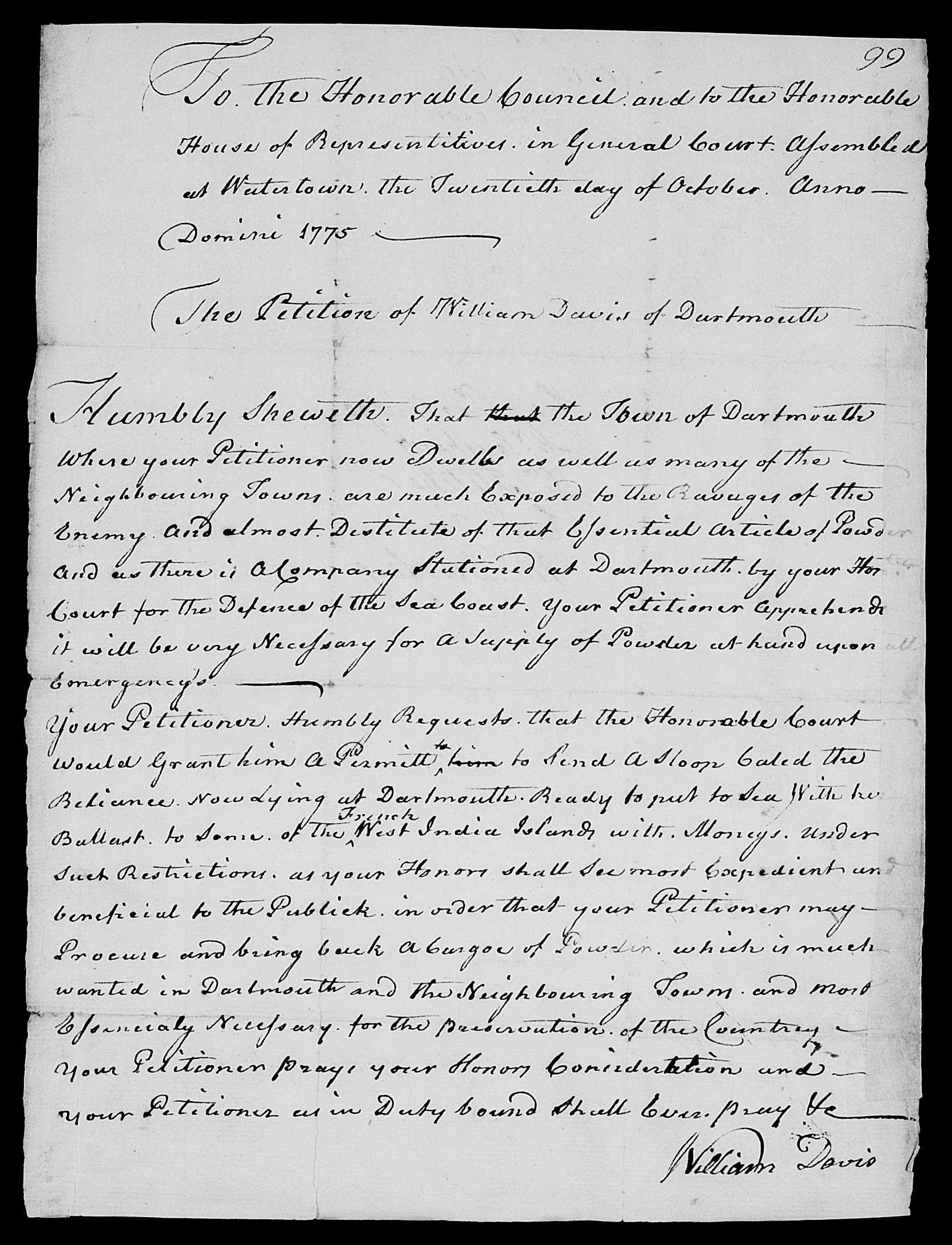
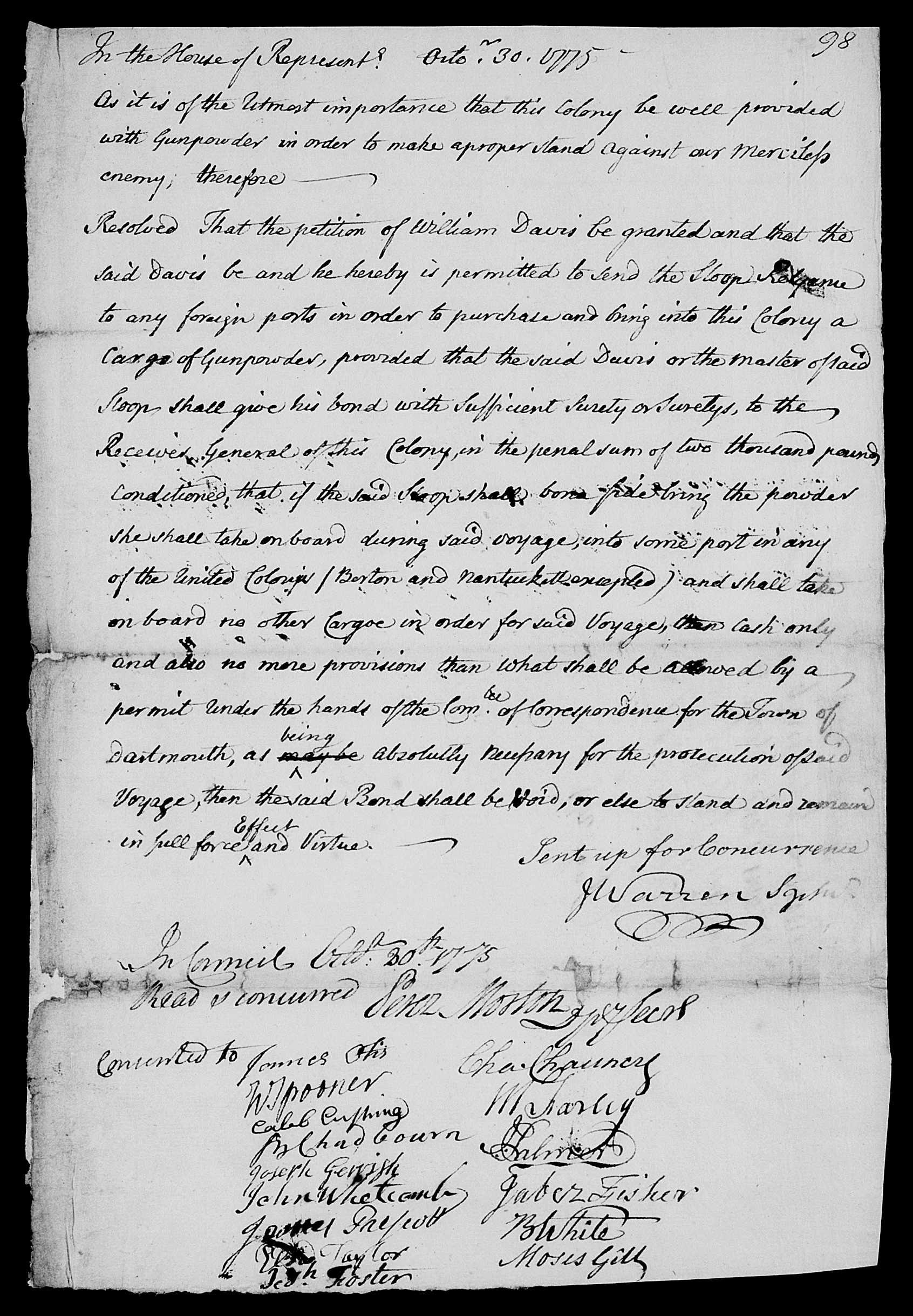
The South Coast was “much exposed to the ravages of the enemy and almost destitute of that essential article of powder,” Dartmouth Selectman William Davis wrote in October 1775 to the Massachusetts General Court, the revolutionary governing body that the colonists set up in defiance of the British army in Boston. Davis was granted permission to send a sloop from Dartmouth to the French West Indies to buy gunpowder.
Some of Dartmouth’s town meeting records are lost to time. Everything from May 1776 to February 1779 appears to have gone missing by 1864, according to a note left in the original recordbook. The first known transcribed copy of the records was completed in 1888, after the original records were found in a safe in poor condition.
The Massachusetts General Court ordered towns to debate the merits of independence in May 1776, but minutes of those meetings in Dartmouth seem to be lost.
Much of the decisionmaking during the Revolution happened at the local level, said Lane, the Revolution 250 historian. The leaders of the Revolution depended on the support of the towns, and the people of Massachusetts were proud to be part of the decisionmaking, he said.
“The whole town meeting system is really key to understanding the Revolution,” he said.
Email Grace Ferguson at gferguson@newbedfordlight.org


This is a very interesting rundown on early Dartmouth reaction and action against the British Parliament in 1774 – 1775, thanks Grace; with a hat tip to Westport Historical Society.
Thank you for the article, love reading about local history.