


“Families are looking for something different,” said Rachel Medeiros on an autumn day as she sat in the shade behind her yurt. Nearby, the children of the Elements Learning Collaborative, a drop-off program for homeschooled students, chased each other in games of tag and stick-fighting.
Medeiros had just finished teaching the day’s math lesson on subtraction to three middle-school-aged students — but the importance of grade-levels at Elements, a Dartmouth-based program that Medeiros co-founded in 2018, is intentionally diminished.
A particularly jolting crack of two branches made Medeiros turn her head toward an ongoing fencing match. “We value risky play,” she explained. Kids are supposed to “gauge their strength, gauge their confidence … We let them be a little wild,” she said.
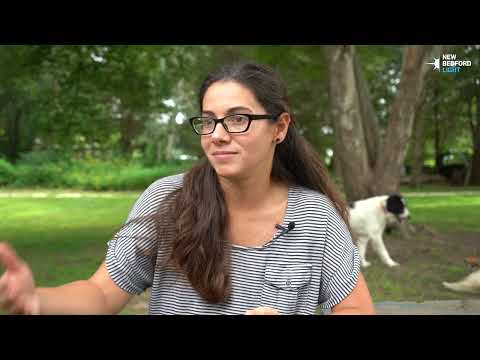
It was all part of the theory of learning at Elements that Medeiros had come to define, along with her co-founder and co-instructor, Cristy O’Brien: that kids learn naturally, and it’s better to let them figure things out at their own pace.
“Conflict comes up for sure, and schools really try to mitigate that conflict,” said Medeiros. She described the typical schoolyard recess as a time when teachers would regulate which games kids can play and then step in to resolve their arguments. Medeiros said that approach was likely to stop all creativity and growth. “We give [students] the opportunity for play, but supervise and support them when conflict arises.”
Such free-spirited theories of learning are part of why Elements now has a years-long waiting list. Some parents have put infants in the queue, Medeiros said, hoping that a spot will open up by the time their child turns 4, which is the youngest age to enter the nature-based learning program here.
“Every town would fill up immediately if they had a program like this,” Medeiros said.
It’s likely she’s right. In Dartmouth (where Elements is located) and neighboring Westport and New Bedford, homeschooling has doubled since before the pandemic.

Her program has caught on, Medieros believes, because traditional school “works for some kids but not everyone.” Learning standards and grade-levels, for example, focus too narrowly on academics. Lacking the proper emotional tools “can make some kids really aware of where they’re at in comparison to their peers, which can be detrimental to self-esteem.”
The lessons and activities here promise those emotional tools alongside some academics, but they are supposed to supplement a parent’s homeschool curriculum, not replace it. Up to three days each week are available for accepted students, but some families opt into less, coming just one day. A typical session lasts about between two and four hours through the fall, winter, and springtime.
The site itself is nestled within a small meadow on Round the Bend Farm, an all-organic operation in South Dartmouth that grows vegetables and raises livestock. Even with the pigs and goats, the farm is near enough to the coast that you can smell the ocean and treetops sway in an ever-blowing breeze.
Inside the yurt, warm colors and soft textures ooze throughout. Students and visitors leave shoes by the door, and a circle of unfurled yoga mats and blankets surrounds an antique wooden easel. The one-room interior is expansive — stretching about 50 feet in diameter beneath an upwardly conic ceiling and a central skylight.
Around a small table, O’Brien, the other founder and instructor, works with several youngsters. They’re copying stanzas from the poem “September,” by Helen Hunt Jackson, which was selected in honor of the autumn equinox.
O’Brien taps the table in front of one boy to attract his attention to the paper. He had managed to copy a few words, but his letters are messy, and some might be backwards. Would he read some of the poem, a visitor asks? The child puts his finger to the page. “S- S- Sep-,” and stops to think. While looking up, he remembers the name of the poem and says it aloud, “September!”
Then he looks down to read the next word, “H- H- H-,” and looks up again, but he cannot remember this word. It takes a little bit of time to identify the letters, but he works himself to “Helen.” All of a sudden the rest of the poem seems long.
He turns to talk with another boy about their typical activities on the days when they don’t come to Elements. “Mostly games and watching stuff,” they agree. Which games? “Mario Kart,” he says, but he laments that his mom’s friends don’t let him win.
The boys say they are 7 and 8 years old, or about the age of third graders.
Soon enough, poetry ends, and the eight or so elementary schoolers burst out of the yurt and into the meadow to rejoin the older kids. They find their sticks and reform old alliances, with plenty of time now for exploring and rollicking.
Email Colin Hogan at chogan@newbedfordlight.org
Editor’s note: This story was amended on Feb. 27, 2024, to remove the nicknames of children.


