


|
Getting your Trinity Audio player ready...
|
New Bedford’s Chris Cardaci has built a life around pinball. What began as a childhood fascination has grown into a profitable profession. Since launching Chris Cardaci Pinball Services in October 2023, the 43-year-old is employed full-time repairing and refurbishing pinball machines throughout the South Coast and Rhode Island.
At the same time, he fills his coffers as an “operator,” leasing a stable of 26 machines to area establishments. In his spare time he competes on the machines — he is currently ranked third as a player in the Rhode Island area.
Cardaci is a proud “Pinhead.” For him, pinball is simultaneously an enjoyable interest and a rewarding industry that puts fervor in his heart and food on his table.
Cardaci says pinball is a world unto itself, with local, national and international cultures. For some, the game is for passing time at a bar or a restaurant, a fleeting fancy at an arcade. But for others, it can be a passion that goes well beyond a hobby.
If you’ve been away from the game since your youth, you may be amazed at the advancements it now boasts. The cost of pinball machines can reach upwards of $15,000, and include a variety of eye-catching features such as videos, music and intricate layouts and designs, spanning an array of themes.
Cardaci, a graduate of New Bedford High School, is also a sought-after percussionist who performs regularly throughout eastern New England, in addition to giving drumming lessons out of his home. He has a bachelor’s degree in percussion and performance from UMass Dartmouth and a master’s degree in the same field from Eastern Kentucky University.
Cardaci spoke with The Light about his devotions to pinball, including his business interests and his ambitions for the future, how he got interested in repairs and restoration, competing at pinball, and how the machines have evolved over the years.
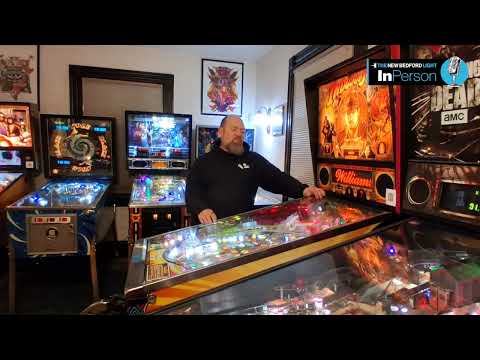
New Bedford Light: Were you playing pinball machines before you began fixing them?
Chris Cardaci: Yeah. I have memories of playing pinball when I was a young kid going to pool halls with my dad. My dad was a huge pool enthusiast. He played in competitions quite a lot so there were plenty of times when he would go out and play pool and I’d ask to go with him. He’d take me along and a lot of times it would be me hanging out and watching.
I didn’t play that much pool when I was younger but there was always a game room or a video game or a pinball machine. So I have memories of growing up playing pinball. It was always kind of there.
As I got older, in high school and college, I really started playing more casually with friends or whenever I played a show in a place that had one, I could be found playing pinball for sure!
NBL: What was the lure for you? What attracted you to it and why have you stuck with it?
CC: When I was a kid it was a combination of flashing lights and trying to get the ball to do different things. It was more of a casual thing growing up but it was always there. I just enjoyed my time around pinball machines. A lot of times it was chasing high scores or competing with friends.
Nowadays one of the things that keeps me going is the technology that’s out there. The newer games are really exciting to play, especially with the different themes and designs and how they integrate that into an old school game is pretty fun.
There’s also the tournament scene. As I’ve gotten more into this hobby there are tournaments and leagues that meet weekly. The more I’ve gotten into pinball the more and more avenues I dive into. That’s one of the things that keeps me interested. There’s no shortage of stuff to learn.
Also from the tech side of things, now that I work on them, I enjoy them not just as entertainment. I’m learning how they work and how best to repair them. It’s a combination of all that stuff that keeps me coming back.
NBL: How did you get into competing at pinball?
CC: It’s interesting. So for a long time I had no idea about competitive pinball myself. What really got me into it was when I got more into repair. When I was introduced to the Providence scene — particularly at Pizza J — it grabbed my attention. Pizza J has tournaments on the second Sunday each month that anyone can enter, and there’s usually a different format each month, but the goal is the same. Play your best pinball and take home the top prize! There’s an amazing scene in Providence, we’re super lucky!
NBL: How have pinball machines evolved?
CC: There’s a lot of different eras of pinball. The games from the ’60s through the early ’80s are called “street level games” where there were no ramps or mechanical things that would make the ball go above the level of the wooden play field. A lot of the games had fairly simple layouts and revolved around fantasy or sci-fi, something like that.
The competition really was to see how many free games you could win. All the games from the ’60s to the mid-’70s are considered electro-mechanical games.
Anything in this era is going to have score reels, instead of digital displays. Bells and chimes instead of digital sounds. As of the ’80s there were a lot more circuit boards being integrated into the machines and this era is what we consider solid state machines.
In the early to mid-’80s we started seeing ramps being introduced where the ball will travel up a ramp and go up into a second level or a different place in the game. There was more action within the game.
The games also started getting more complex as you added circuit boards — you can then start to add more rules, there’s more capacity for software to be added. It’s really interesting to see how the games have progressed.
Within the solid state era, when you get into the ’90s the displays get more intricate, you start seeing games released with dot matrix displays where you can put images and animation on the screen as opposed to just words on an alphanumeric display.
Another of the things I enjoy is knowing the different eras of the games. The different eras all have their quirks, or a certain set of criteria that go into their function.
Knowing the different eras helps me as a repair tech because I can walk into a room not knowing what the actual problem is in a certain machine, but can track it quickly knowing what to look for based on the era of the machine.
NBL: Is there a culture around pinball?
CC: Yeah. In the internet age there are folks who have entire social media pages devoted to pinball in general, with info on the newest releases or game-play tutorials. They do strategy tutorials. There are a couple of online magazines, Nudge magazine is one. Another one is called Kineticism. Nudge is actually a print magazine, but they don’t publish a lot of copies because what pinhead doesn’t love a collectible? The magazines have a lot of content in them — things like strategy and tournaments, social aspects of pinball etc.
NBL: With the tournaments, do people actually win money?
CC: Absolutely! The ones that we run at Pizza J or The Dusty Planet — one of my other locations — there will usually be a $10 buy-in and $1 of that will go to the International Flipper Players Association, which is the governing body of competitive pinball tournaments.
The rest of the money goes into a pool for the players and we usually divide it up depending on the format, depending on the tournament. Usually the top four will receive money. It’s usually based on attendance: the more people that participate, the bigger the prize.
With the IFPA, there’s an opportunity to earn points that go to a yearly system and at the end of each year there’s a state championship tournament for the top players in each state. If you win the state championship you’ll get invited to the national championship. It’s a lot of fun. It’s really an awesome community.
I have a bit of a competitive side in general so pinball scratches a lot of itches for me. In addition to the one-off tournaments every month, we have leagues where you can play weekly. The leagues are open to any players who are interested. There’s no skill requirement. The leagues are a way to get new players into the competitive way of playing without there being too much pressure. They’re a fun way to get into playing.
There are a lot of different leagues that have seven- or eight-week sessions, and a finals tournament should you qualify over the course of that season.

NBL: Are there techniques and nuances when it comes to playing pinball seriously?
CC: Usually the first thing I try to do is, when I look at the game, if you look at the very bottom of the playfield, there are two little cards. One of them will tell you how much it costs to play the game and what the high scores are.
But there’s another card that will give you tips and tricks about how to play the game. Some of them will actually give you all of the rules of the game. So I usually try to look at that first just to kind of get an idea of what to look for and shoot at.
But in terms of technical ability and skills, there’s what we call “flipper skills,” which is basically understanding how to use the flippers, and then “nudging,” which is physically moving the machine to manipulate the ball and where it goes.
There is a tilt mechanism so nudging is very much an art. Too much nudging and you’ll lose the ball. Too little nudging, and you can still lose the ball!
There’s all these different techniques. There’s the “dead flip,” “post pass,” “flick pass,” “drop catch.” I could go on, but there’s all these little techniques of ways to get the ball to do what you want it to do, as opposed to just flipping blindly and hoping the ball goes somewhere good.
The ”post pass” is where you stop the ball on one flipper and you get the ball to sit. We call it a “cradle.” You have the flipper up and the ball sits in that space. There’s a post above it and if you hit the ball into that post you can actually transfer the ball over to the other side safely. So depending where you’re aiming for, you can then get the ball to go where you want it to go a little more easily. And it looks impressive, too!
NBL: How are modern pinball machines different from the ones most people grew up with?
CC: The technology has grown by leaps and bounds, especially since we were kids. So now the games have full LCD screens, some of which show animation and some of which show footage. Some of the games that have come out recently that are music oriented will actually have concert footage of the song that the machine is playing while you’re playing the game.
The games that have come out since 2017, they actually all connect to the internet. These machines have a whole set of capabilities where you can earn achievements, much like you would if you were playing Xbox or PlayStation. As you’re playing the machine, if you achieve something like a multi-ball or a certain mode, or if you do a certain thing in the game, you can actually earn achievements.
It gives you a badge online that you can go and check. It also has online leader boards where you can see how you rank compared to players from all over the world, as opposed to how you rank locally at a bar where you’re just trying to beat your friends. Now you can compete globally.
The pinball world has really changed.
NBL: Do you play anything besides pinball? Video games or foosball?
CC: It’s funny you should say that. I’ve always kind of fancied myself as a gamer. I played video games growing up, until the last 10 years or so. I enjoy bubble hockey, it’s amazing. And I like sports as well. But these days I’m pretty much all about pinball.
NBL: How did you get into repairs and restoration of pinball machines?
CC: This goes back about 15 or 16 years. I was just out of college. I was working full time and I was always interested in pinball. I always wanted to play more pinball, and so I decided to go and buy my own machine.
So not knowing any information about repairs I went out and found one that I liked — a 1979 Gorgar. It was the fantasy theme that really sparked my imagination. That was the thing back in the day. It wasn’t anything intellectual property based, it was all fantasy-based, and Gorgar was the first talking pinball machine. It was pretty cool.
It didn’t work when I bought it, so I knew that if I wanted to play pinball, I would have to learn how to fix it. So that’s what really sparked the repair side of things. It was really just the drive of wanting to play more pinball.
NBL: Did you have any mechanical background, or was it just learn on the fly?
CC: It was mostly learning on the fly. Growing up, my dad was an electrician by trade. He went to trade school and he learned a lot of the trades. So that was kind of his hobby. He did everything from woodworking to drafting to electrical.
We used to have all kinds of hobbies growing up, whether it was toy trains or remote-controlled cars or different things like that. So I kind of had a little bit of a background as a hobbyist.
But it was more learn by doing, as opposed to learning it out of a book or being trained. It was a little bit more of a school-of-hard-knocks kind of thing, but I had good teachers in my father and my grandfather. I was taught how to turn a wrench and all that.
NBL: What led to opening the business?
CC: The more I got into the hobby, the more I recognized the need for someone to do these types of repairs. So about 15 years ago when I bought my first machine, I initially tried to get someone to fix it for me.
I was willing to pay them to fix it. The problem came when I tried to find somebody. Either they were too far away, they wanted to charge a crazy amount of money, or sometimes it seemed really shady.
So it was really difficult to find support for the repairs and the things I was looking to do. So it forced me to learn the stuff on my own. But as things progressed I fixed Gorgar. I got it up and running and then I was addicted. I was looking for the next game I could get my hands on and bring back to life.
At that point, some of it was buying games that I liked, and what was out there. So the next game I bought was Space Mission, and that was an electro-mechanical game, versus the solid state that Gorgar was.
Now I’m not only learning about the solid state stuff, I’m now learning about the electro-mechanical stuff. So that really broadened my horizons and my knowledge base and what to look for in these things.
Basically it was a lot of that — a hardcore hobby where I got really excited about learning how to fix these things so I could get the next game I wanted to play. So I’d pick one up, figure out what’s wrong with it, and I’d do all the research.
I did this over and over again — buying a game, repairing it, getting it to run. I might trade it to someone or sell it and buy another one. And this went on for about 10 years or so.
Sometime after the pandemic I was really in a different place. I wasn’t working full time, I was teaching music and performing music, and I knew I had this pinball skill set. By going to pinball shows and expos that were happening, I realized there was this niche market that I could tap into.
And so in 2023 I started Chris Cardaci Pinball Services, essentially for restoration and repair services, and within that first year or so I did a few restorations for some people and a few random house calls here and there, and I was playing even more pinball. I started getting introduced to some people in the Providence pinball scene, and that’s what kind of got me into operating as well.
NBL: What does “operating” mean?
CC: It means placing a machine at a bar or a restaurant. The games are coin-op. Some places do coins, some places do tokens. The games are pay-to-play out there for people to enjoy. I’ve got three places in Providence but I’d like to expand into the New Bedford area. Operating is another avenue in the business.
NBL: What is the range of themes for pinball machines these days?
CC: Anything from your favorite rock bands to the latest and greatest Marvel movies to some fantasy stuff. One thing that just came out recently is Jaws. The game features scenes and call outs all from the original “Jaws” movie. Richard Dreyfuss does some custom voice-acting for the game, which is really wild.
With the new tech side of these games, if that Jaws pinball machine was released in 1979 it would not be anywhere near what the recent release is like. This one has ramps, there’s a shark that comes out from under the machine and it eats the ball, all of this really cool stuff.
It’s eye-catching. I sit in any of the places that have pinball and I see people walk in and they light up when they see all of these machines that are so spectacular, watching where the ball goes and all of that.
NBL: Are there any people who are considered rock stars in the pinball world?
CC: There are several. There’s one guy in particular named Steve Ritchie, who is a true rock star of the pinball world. He’s a designer who’s been designing since the 1970s. He’s responsible for some of the greatest machines ever made. He’s also one of the guys who’s responsible for the video game Mortal Kombat. He really is a rock star in terms of gaming. … The last game that he released was an Elton John pinball machine.
This machine has everything in it — ramps, spinners, incredible light shows. There’s no stone unturned. There’s literally a little figurine of Elton John playing a piano. When the music is playing, the little figurine is making movements rhythmically that sync up on the piano. The piano has a screen on the side of it that scrolls messages at the same time. It’s really incredible stuff in terms of presentation.
NBL: Do you see yourself designing machines someday?
CC: It’s funny that you should say that. I come at pinball more from a reverse engineering perspective. I appreciate design, but I’ve never really put thought into designing one myself. Never say never!
Sean McCarthy is a freelance writer and frequent contributor to The New Bedford Light.
This interview has been edited for length and clarity.


